on honesty, ambiguity, and the building of shelter for the vectors of integrity in observational drawing
To draw from life is to look hard at a person and make of them, for a while, an object of attention. A common trick is to pretend you are doing no such thing. This essay declines the pretence, and asks what is left once it is gone.
The disavowed gaze
Observational drawing begins in a small, unremarkable violence. You fix your eyes on someone who has agreed to be looked at, and you set about reducing them: to line, to mass, to the fall of light across a shoulder. For the length of the pose they are, to your hand, less a person than a problem of edges. We keep polite words for this. We call it study. We call the person a model, a sitter, a figure, as though the noun could launder the act. And mostly we look away from what the looking is. The gaze that drawing depends on is an objectifying gaze, and the long tradition of the life room has been remarkably good at not saying so.
The disavowal is the interesting part. A workshop that asks models to pose as objects — a chair, a doorway, a tree — does only one genuinely new thing: it stops pretending. It takes the quiet objectification that was always in the room and says it out loud, gives it a name and a shape and, above all, asks permission for it. The conceit is playful, even absurd. A body folded belly-up on all fours, doing its honest best to be a recliner, is funny before it is anything else. But the play is the method. It is how a thing too heavy to discuss head-on becomes light enough to pick up and turn over.
Three words, one act
Lay the three words side by side and the recursion is hard to miss. Drawing is objective: it proceeds by looking, by patient empirical attention to what is actually in front of you, about the most honest form of seeing we have. Drawing objectifies: that same attention renders the sitter an object, a thing studied. And the workshop’s whole subject is objectification, the concept, with all its careful philosophical freight. Objectively objectifying objectification is less a pun than a description. The honest gaze makes an object; the object is a person; the person has agreed to be, for an afternoon, the object of a study about objects. Each turn of the word holds the others inside it.
Here is the ambiguity the whole thing rests on, and which I have no intention of resolving. Martha Nussbaum’s argument — that objectification is not one thing but a cluster of distinct features, several of which, under consent and rough equality, can be benign rather than harmful — is the philosophical floor.1 But the cycle that occasions this work, Jake Heggie and Philip Littell’s Eve-Song, says it more economically than any philosopher: to be visible is at once to be warned and to be invited, with no way to know which. To be seen is to be exposed and to be met. The object-pose holds both at once and declines to settle. You cannot tell, from outside, whether a body made into a doorway has been diminished or honoured. That undecidability is not a flaw in the exercise. It is the exercise.
An honest objectification
What does naming it actually buy? Not innocence. Naming the objectification, choosing it, consenting to it, does not convert an extractive act into a tender one by decree. It would be a comforting story (we said it aloud, therefore it is clean), and it would be false. Consent can be hollow; equality can be quietly absent; a facilitator who has authored the frame and invited the risk holds more of the room than he likes to admit. The dignity the exercise depends on is not a switch thrown at the start. It is built and watched, pose by pose, and it can fail at any one of them.
So the honesty here is modest, and it is real. The ordinary life room offers a disavowed objectification: it objectifies and looks away from the fact. The workshop offers an avowed one: it objectifies and keeps its eyes open. That is the whole of the difference, and it is not nothing. An avowed objectification can be argued with, refused, renegotiated mid-pose; a disavowed one cannot, because officially it isn’t happening. To make the act sayable is to make it answerable. The relation does not become honest because we named it. Naming it opens the possibility of an honest relation, and then the room either keeps that possibility alive or lets it quietly die. The model who can stop the pose with a word, step off the stand, veto the prompt before the room ever sees it — she is not kept safe by our good intentions. She is kept safe by an exit that actually works.2 Honesty is a practice, not a property. It has to be re-earned every fifteen minutes.
The room as shelter
If the gaze cannot be made innocent, it can be housed. This, in the end, is what the workshop is for, and what the guide and the proposal around it are for: not to purify objectification but to build a room in which it can happen without anyone in it being flattened. The architecture is unglamorous: a stop signal, breaks nobody is quarantined from, a fee that opting out never touches, a prompt-pool the models hold a veto over, documentation only by specific consent. None of it is profound on its own. Together it is a structure of care, a shelter; and what it shelters are the vectors of integrity — dignity, consent, authorship, risk, attention — the forces a careless room flattens and a built one can hold apart, intact, in tension with each other.
I mean shelter almost literally. A shelter is provisional: it never pretends to be the end of the weather, only a place to stand inside it. It is revocable; you may leave. It is made of ordinary materials, arranged with care. And it holds more than one body. The model is exposed in there, but so is the one drawing — to look is to be implicated, and to be seen looking, doubly so. Vulnerability in that room is distributed, not assigned. The shelter is for everyone standing in it, which is the only kind of shelter worth the building.
Eve, idols, and the hands that made this
A question I will pose and decline to close, because it belongs open: is idolising Eve patriarchal? A certain reflex is to say no. Surely to honour the first woman, to give her a contemporary voice, is reparative, the opposite of the long slander that named her the origin of every fall. And yet idolising and blaming may be one gesture in two coats. An idol is an eidolon, an image; to idolise is to relate to the image and not the person. Patriarchy’s signature is exactly that pendulum, Madonna and whore, pedestal and gutter, and both poles are objectifications, both swapping a woman for a picture of one. To lift Eve onto a pedestal is still to fix her as a single image, only a kinder one. A more honoured cage is a cage.
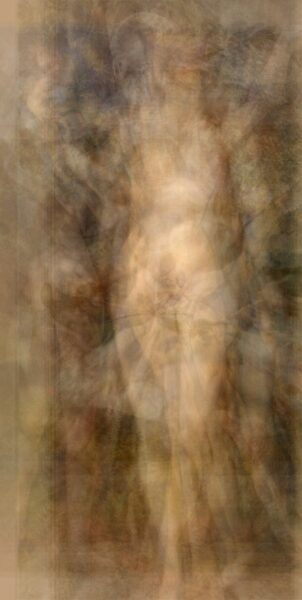
The way out, if there is one, is not to choose a better single image but to refuse the single image as such — which, as it happens, is what the layered-averaging works in this show already do. Thirty-five painted Eves, held at equal weight, none of them winning: not an idol but its dissolution, a face that is all the faces and therefore none, visibility without resolution. Eve as simultaneously-many is the anti-idol, and it rhymes precisely with the workshop’s move at the scale of a single body: refuse the one fixed reading, hold the ambiguity, keep her many and unresolved and present. Idol or scapegoat, pedestal or gutter: the practice declines both, and reaches for presence instead.
Which leaves the last and least comfortable turn. This whole edifice (the workshop, the guide, this essay, the statement that has had the nerve to call itself an artwork) is a meditation on integrity assembled, footnotes and all, with the very multi-agent machines now unsettling the academy whose forms it borrows.3 The gaze that objectifies a body and the system that objectifies knowledge are not distant cousins; they are the same move at different scales, and I am running both at once. So the shelter has to be larger than I first thought. It must hold the sitter and the scholar, the drawn body and the automated thought, and it must admit, in plain words, at the foot of the page, that the one building it is also among the things it is trying to protect. An honest statement discloses the hands that made it. These are the hands: a person who works slowly, and the fast machines he is learning, warily, to work alongside.
The mirror needn’t clear. The smoke needn’t settle. To draw from life, honestly, is to stand in front of another person and refuse two lies at once — the lie that you are not making them an object, and the lie that you must therefore not look. You look. You name it. You build a room warm enough to do it in. And you leave the door standing open. En tog. That is most of what care has ever been.
Notes
- Nussbaum, “Objectification” (1995) — hers, hosted here, not mine. The cluster runs to ten features once Langton’s three are counted; this workshop courts perhaps four of them on purpose and works hard to keep three others (violability, denial of subjectivity, silencing) out of the room entirely. The whole apparatus is an attempt to stay on the benign side of a line that Nussbaum is honest enough to admit the powerful find a good deal easier to locate than the powerless do. ↩
- “If the exit is hidden, the consent is fictional.” The line is the author’s own, said often enough now to be at risk of becoming furniture — which, given the subject, may be the appropriate fate for it. ↩
- Written with, not merely about, multi-model multi-agent computational intelligence — the human-and-machine assembly is named in the colophon rather than hidden in it. If a meditation on how knowledge gets objectified is going to be produced by the leading edge of knowledge-objectification, the least it can do is say so, and not tidy the irony away. ↩
Companion works
The three composites and the essay that frames their method:
- Study of Eve
- Shroud of Eve
- Twelve Refractions
- How to See Eve — the companion essay on layered averaging.
Colophon
The capstone of a small constellation — the practice guide, the workshop proposal, and this essay — which together mean to stand as a work in its own right. The three composites show in Eve Song — A Happening at the University of Pretoria (July–August 2026), curated by Sue Clark. Lyrics are paraphrased only; the libretto and setting of Jake Heggie and Philip Littell’s Eve-Song are rights-held and not reproduced. The “mirror / smoke” lines and the title string of words are the author’s own. Composed via Parametric Authorship.
Concepts referenced
Further reading in the README repository:
- Objectification — the working note on Nussbaum’s cluster and where this practice tries to sit against it.
- Parametric authorship — the operational lens: the work held in the rule-set as much as in the print.
- Voice signature — the register this prose tries to keep within.