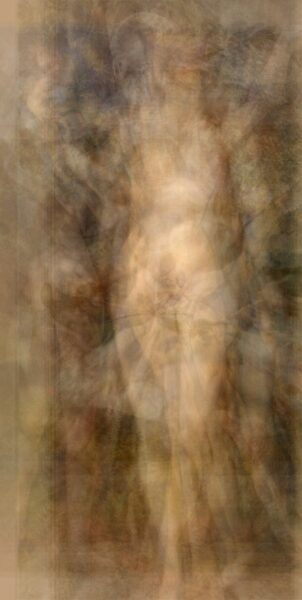
No single painter made this Eve. Thirty-five of their paintings did.
What you see is a standing figure gathered at a single axis, luminous through the middle and thinning toward the edges, a body that is every body and so is no one’s. Dürer’s Eve is in there, and Cranach’s, and Masaccio’s, and Valadon’s, and Anna Lea Merritt’s, each held at the same one-thirty-fifth weight as the others. None of them is centred. All of them are present. What rises in the average is a figure none of the paintings alone contains: Eve as a sum of how she has been pictured.
This is Study of Eve, the first of three composites made for Eve Song — A Happening (University of Pretoria, July–August 2026, curated by Sue Clark), an interdisciplinary happening built around Jake Heggie’s song cycle Eve-Song. The cycle is carried by Ailyn Nienaber, a doctoral candidate in voice at the University of Pretoria, and the three composites sit alongside her performance, with workshops and walkabouts through the run. Two of the works read the historical archive of Eve. One reads a present body in a consent-based life-drawing room. They share a single habit of mind, and the habit is older than the software.
The method, kept where it belongs
The works are made by layered averaging: many source images aligned and held at equal 1/N weight, so that no source wins. I would rather say less about the code than about what the code is for, so a sentence to get it out of the way. The compositing runs in Python (average-paintings.py, composite-16bit.py) on OpenCV and MediaPipe, the faces and bodies located by landmark detection, the averaging done in a perceptually even colour space so what holds the centre is a figure that emerges rather than a smear with figure-like features in it.
The framing I work inside is parametric authorship. The algorithm does not author the image. The image is afforded by it (afforded, not caused). What I author are the parameters: which sources, which alignment regime, which curation depth, which treatment of tone. The press is automatic. The choosing is not. And the ethical position sits in the 1/N, which is arguably the least technical and the most load-bearing decision in the whole pipeline: equal weight, no Eve crowned over the others, a quorum rather than a queue.
One archive, read two ways
Study of Eve and Shroud of Eve draw on the same thirty-five paintings. What separates them is the question put to the alignment.
Study asks where the body is, and aligns on that. The historical Eves are lifted out of the stories that hold them (Garden, Fall, Annunciation, altarpiece panel) and stood up at a shared axis. The canonical standing nude turns out to be a composite all along: every Eve sharing the same spine, luminous at the centre, thinning outward.
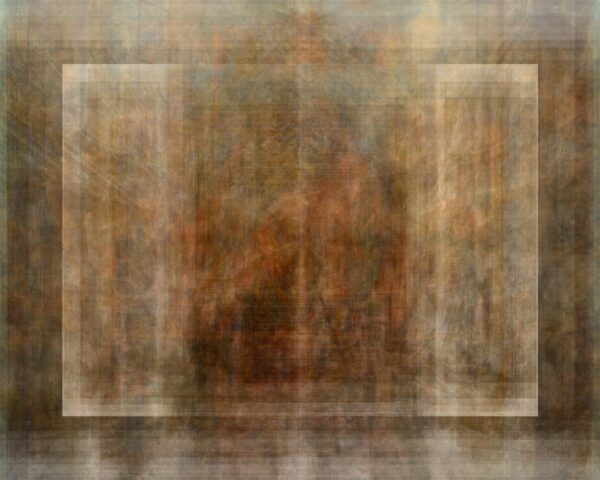
Shroud asks where the body sits in its own picture, and aligns on that instead. Each painting keeps its narrative placement, so the figure recedes under the accumulated architecture of her iconography. A rectilinear archive closes over the organic form, and what remains is the subtlest texture of her presence (a warmth, a turn, a paleness where a shoulder was).
And here is the turn the two works make together. Shroud, which looks the more abstract of the pair, is empirically the more concrete: thirty-five paintings held exactly as they are, each source keeping its full pictorial context, Eve’s position in each one untouched. The abstraction is on the surface. Underneath it, nothing has been moved.
A present body
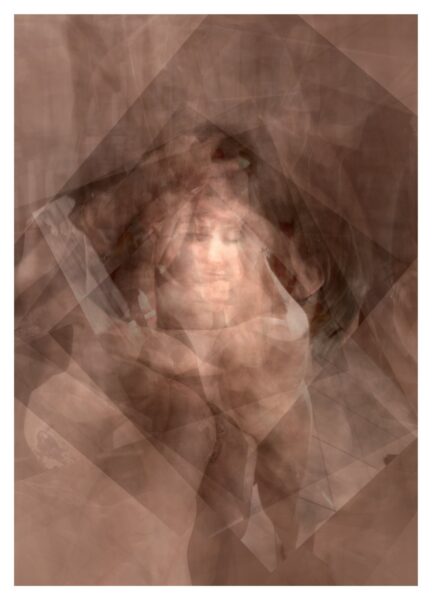
The third work turns from the archive to a room. Twelve Refractions comes from a single life-drawing session (Andrea, 22 November 2025, a consent-based gathering at Life Drawing Randburg, in a round called Roles Circulate). Twenty-four photographs from that one Saturday are processed twelve ways, each refraction a different answer to one question: how should we align this body? Eyes, shoulders, torso, full figure, the brightest clusters of light, no alignment at all. The twelve answers are then held together at equal 1/12 weight inside one frame, which works out at roughly one-two-hundred-and-eighty-eighth of the image carried by any single photograph (where that photograph appears at all).
Refraction, the title says, and not fragmentation. The same light passing through twelve lenses and recombined, the source stock unchanged, what bends being only how we look. The image area sits at √2, the A-series proportion (the one rectangle whose halving keeps its own shape), so the frame refracts into itself at every scale the way the body refracts across the twelve. Around it, a margin of untouched white paper: edges declared, no bleed, no pretence of infinity. A work you can pick up.
The session matters to what the picture is allowed to claim. The model is a co-participant (the work carries that provenance), and the twelve refractions are a way of refusing to settle on a single true face. Twelve Refractions, drawn from one contemporary person in one specific room on one specific Saturday, comes out somehow the most abstract of the three: less a figure of Eve than a study of her beingness. The apparent concrete holds the most abstract. The apparent abstract held the most concrete. The trio runs on that inversion.
The song
Heggie’s cycle gives Eve a contemporary voice across eight songs, and it makes a move these pictures recognise. “My entire body ripples up and down like a story,” Eve sings (the body as text, which is what a life-drawing room is for). Visibility, in the same cycle, is “a warning or an invitation, and it never tells you which” (the deliberate ambiguity I work toward when a figure is present and unresolved at once). The cycle refuses to choose between Eve-the-woman, Eve-the-mother, Eve-the-lover, Eve-the-child, Eve-the-sage, and insists they are the same figure. An average insists on the same thing, by other means: many held at once, the composite identity kept composite.
A man averaging images of Eve is not a woman singing them. The formal structure permits a feminist-informed reading and does not claim one. And yet the structure is what it is: thirty-five voices at equal volume, a forest of Eves in which no tree dominates the canopy.
And yet
What the method does not claim is that this is who Eve was. There is no who. Eve arrives already a category, a way the West learned to picture a woman, and the composite is honest about being a representation of representations. The averaging makes something that never existed. The work is in keeping the not-existing visible.
What it also does not claim is that equal weighting is automatically just. To average a body (a historical one, or a present one who has consented) is its own kind of pressing, and the dignity-conservation move sits in the 1/N, and the 1/N does its work, and the question does not therefore disappear. The hand is here. A man does what he can with his looking, and says so.
I think the question I keep is a simple one: how to see Eve. I see that Eve withdraws. I see that Eve is still, and that stillness is not negation. I see that Eve’s withdrawal is perhaps also Eve’s unfurling.
Notes
The three works show in Eve Song — A Happening at the University of Pretoria (July–August 2026), curated by Sue Clark of Equilibrium Studio, with vocal performance by Ailyn Nienaber. The prints are framed by Ryan Hitchcock of The Art Room, Parkhurst. All three are available, and enquiries are welcome via the gallery and the studio.
The thirty-five historical paintings are sourced from Wikimedia Commons (Public Domain and Creative Commons), with full per-painting attribution held in the provenance ledger accompanying this work. The lineage runs back: layered averaging began in this practice with the Composers I–V series (2012) and continued through the bodyTime() double-exposure life-drawing series (2017–). The software is new. The ethic (equal weight, no source crowned) is not.
Concepts referenced
Further reading in the README repository:
- Parametric authorship — the operational lens. Meaning held in the mapping from rules to outputs, the work being the rule-set as much as the print.
- Hyperstrate — the protocolled field in which sovereign peers attest to claims. The 1/N as a quorum, not a queue.
- CARDS — needs construct (competence, autonomy, relatedness, dignity, safety). The dignity-conservation move sits here.
- Voice signature — the register this prose tries to keep within.