A thought I keep returning to (while stretching before a life drawing session, while waiting for paint to behave, while running code that models something it will never touch): the body is where it all starts, and where it all ends.
I mean this in the plainest possible way. The charcoal in my hand leaves dust on skin. The model standing in the room is holding a pose that costs something, physically. The drawing I’m making is a record of that cost, and of my attention to it. Whatever else I’m doing (Landscapifying, coding, philosophising), it comes back to this: a body in a space, marking place and time.
The log
A body keeps a log. Scars, creaks, the memory in a muscle of how it was strained and how it adapted. I think of this as something like a commit history written in flesh (a maculate git log where nothing is ever truly deleted, only buried under subsequent layers).
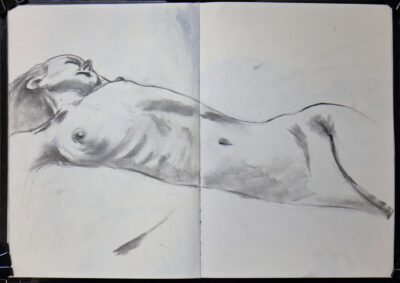
A sketchbook keeps the same kind of log. The earliest spreads from a recent run of Life Drawing Randburg sessions are atmospheric, exploratory, the charcoal still finding the session’s language.
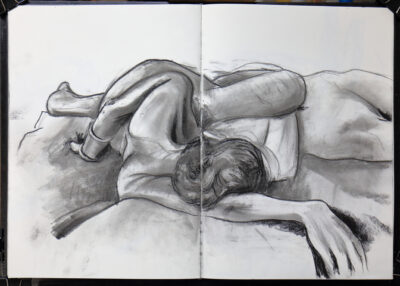
Then a figure spans the full spread, body continuous across the gutter. The binding becomes terrain before I’ve named it that. Each page carries forward what the previous one deposited.
A painting accumulates the same way. The MOON painting I showed at Trent Gallery carried months of archaeology beneath its final surface, each layer a record of a different encounter with the canvas, a different state of attention. Legacy code as scar tissue, functional and ugly, carrying the memory of decisions made under pressure. The parallels are genuine, arguably. A system (a body, a painting, a sketchbook, a codebase) that shows its history honestly is more trustworthy than one that pretends to be clean.
Pyngenot. Pain-pleasure. A word that only exists in Afrikaans, and that I keep needing.
The interface
In the bodyTime(fugitivity) prints, I layer two moments of a figure onto a single surface. What emerges is a body caught between stillness and movement, presence and fugitivity. Carl Jeppe described them as “wonderfully anachronistic, showing us glimpses.” He’s right, I think. The body is the interface where we glimpse what is real (fleeting, fragile, often uncomfortable) beneath whatever performance we’ve layered on top.
Objectification and vulnerability.
How easily both can revolt, be judged.
And yet.
Objectivity and sensitivity.
Razor on skin.
That poem (from “A Razor’s feel”) sits at the tension I keep circling: to look at a body carefully is to risk both objectifying it and honouring it. The life drawing room is a space built for that risk. Consent protocols, timed poses, the quiet understanding that the model is a co-participant. A kind of firewall: you have to maintain the boundary (sovereignty, respect, restraint) before you can open the port (attention, tenderness, the gaze that actually sees).
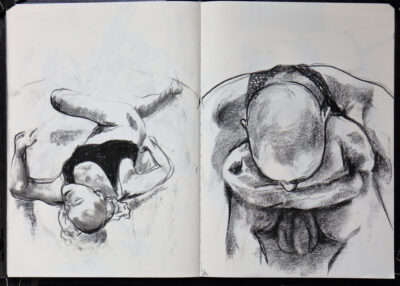
Two foreshortened views from above. Looking down onto the body compresses it. Viewpoint is not neutral; viewpoint is pressure.
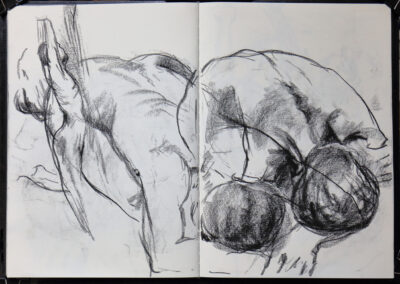
And then something shifts when the charcoal stops describing and starts sculpting. Heavy tonal passages building form through mass rather than line. The gaze commits.
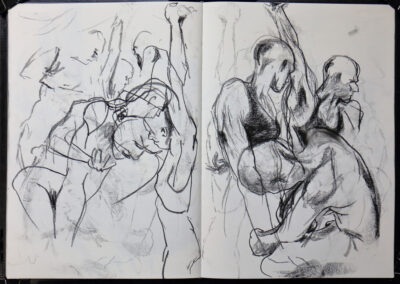
In one spread, rapid figures overlap, arms raised, poses layered on top of each other. The hand accumulating instances of a gesture to find the form underneath. Manual averaging. I ran layer-average.py on photographs from a previous session the same day. The algorithm stacks 24 images and yields an emergent figure. The hand does what the code does; the code does what the hand does. The difference is grain (the hand selects and emphasises; the algorithm treats each source equally, the 1/N ethical position, arguably). Both produce form that neither could predict.
The arena
I’ve been calling the body “the first and final arena” in my working notes, and I think the word arena matters. An arena is a bounded space where something happens. The body is bounded (by skin, by mortality, by the simple fact of being here and not there). And what happens inside that boundary is the synthesis: the discipline of form and the chaos of sensation, forced into collision. The map becoming territory, the territory becoming map.
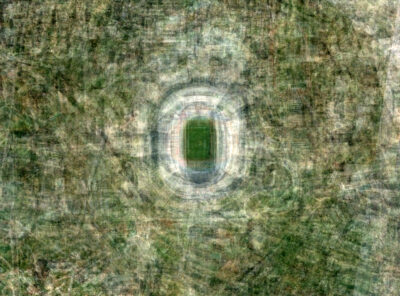
Other arenas exist at other scales. The Temple (2010) composited satellite views of the world’s fifteen largest stadia into a single image, dedicated to “what is arguably the greatest religion of our time, competition.” Same compositing instinct (bodies merged into one image), different magnitude, different motive. Stadia as temples of watching, arena as spectacle seen from orbit. This one is the opposite: the bounded skin, the sketchbook spread, the quiet room. In my worldview there is a constant tension between cooperation and competition that sparks the drama we know as civilisations, culture, history. Competition has had a good run. Sometimes it escapes from being kept in check by counterbalancing cooperation, and there seems to be a lot of that happening in the world right now. One hopes this will somehow be restrained. The logical outcomes of unfettered competition, domination culture, violence, destruction, are not pretty pictures.
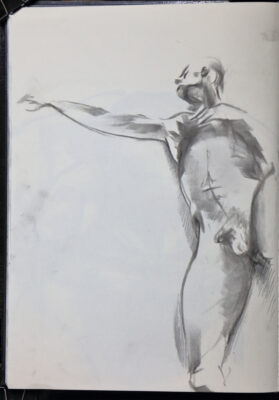
A cruciform pose, isolated. Lighter, more tentative than the mass studies before it. Something about the gesture seemed to call for a response. I didn’t quite realise it at the time, but I ended up selecting a photograph from my archive where a detail of the hand and arm echoed the reaching, and drew that on the facing page.
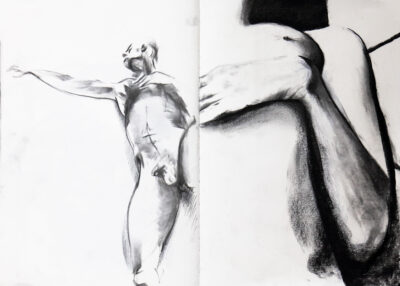
Two pages, two registers. Gustav on the left: open gesture, arms extended, head tilted back. Decompression. Andrea on the right (from photographic reference, session E3: Roles Circulate): cropped shoulder, bent limb, rectilinear dark shadow. Compression. The pairing was not planned (it is the accident of sequential pages in a working sketchbook). And yet. Each page resolves on its own; the pairing opens a reading that neither demands alone. Having been thinking through work for the Eve Song exhibition, the formal structure permits a feminist-informed reading without insisting on one.
The idea of drawing the second half of a spread from reference, searching my archive for a resonance with what the live session produced, is something I want to explore further. The session yields a gesture; the archive answers it.
In my painting practice, Landscapification treats the body as terrain and terrain as body. “Her skin was a landscape where healed-over fault lines mapped previous quakes.” That’s the bodyPaint work: a gaze, a body set aflame, a topography of lost-and-found. In code, bodyTime() is a function that takes fugitivity as its argument (the slipping-away of the moment) and returns something I can hold (a print, a trace). In the life drawing room, the arena is literal: a circle of easels, a figure, and the shared contract to be present. In the sketchbook, it is the spread itself: two pages hinged on a gutter, accumulating a practice’s residue.
What holds across all of these (paint, code, charcoal, facilitation) is that the body is where the work gets honest. You can theorise about connection, about ethics, about consent, about sovereignty. But the body is where those abstractions meet friction. Where they either hold or don’t.
“Die liggaam kan nie vir altyd lieg oor sy toestand nie.” The body cannot lie about its state indefinitely.
(and yet)
I’m aware this could sound like a grand claim, the kind of thing I’d normally hedge with “arguably” or “a kind of.” And there are limits. I don’t have a complete philosophy here (more a working model, version 0.7, subject to the usual caveats about distance-from-wetware). The body I’m describing is also the body that gets tired, that misses things, that has mornings where the charcoal does nothing interesting and the code throws errors and the painting just sits there.
But I think that’s the point, maybe. A philosophy of body that only works when the body is performing well is a philosophy of performance. The arena includes the bad sessions.
The artist designs the parameters; the process yields the form. There is the body that works, and also the body of works. Something like that.