The last post (The First and Final Arena) closed on the sketchbook as a kind of commit history written in flesh. Twelve new pages have happened since.
Also, a poem wanted to live at the seam of all this, and I let it. Its close:
You do not need to be watching.
It all keeps its log.
Doesn’t it?And yet.
That and yet is where this post starts.
Valence
A quick word, first. Valence is chemistry (carbon bonds in four directions, and that is a part of why biology is possible, more or less), and it is also a grammar as wel as grammar (the verb, has a valence, the arguments it takes), and it is also, arguably, a useful word for what a boundary does.
A boundary has more than one face. The sketchbook gutter separates two pages and the gutter registers the dialogue between them. The skin bounds a body and the skin displays that body. The screen contains the image and the screen projects it. One surface, several faces, operating in parallel.
In the working models I’ve been building out in the README repo, the gutter has “usually at least four valences”: skin (containment, sovereignty), sensor (reception), cinema screen (projection), computer screen (I/O). The phrase usually at least is the interesting bit. The count is open. A fifth valence can surface when it earns its keep.
And then the body walks into the life-drawing room, and you can see what I mean.
The session
Sunday 12 April, Arcadia, Pretoria. Carl Jeppe’s life-drawing group. Elli posing. Sketchbook on an easel, upright. A gravity-feed fountain pen, which is a tool that does not obey you the way a pencil does (ink flows with angle and dwell, so pressure is a conversation rather than an instruction). And for the tonal pages: matt graphite, integrated with fine charcoal powder blends and blurs — the drawing is, quite literally, carbon.
I was trying to work the spreads as spreads as well as individual pages (the gutter authored, not incidental). What came out is a run of spreads with an arc you can read in the marks themselves.
Reading the session across its valences
Contour (the skin valence)
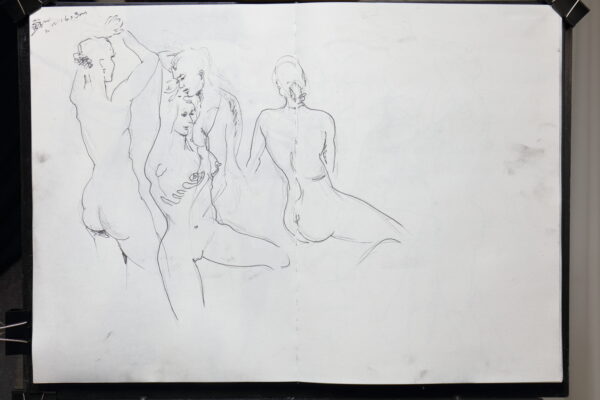
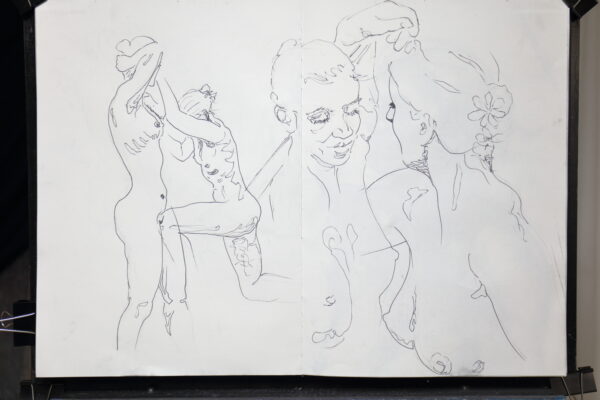
The session’s opening. Four figures from three-minute poses, laid down in fountain-pen line across the spread, no shading. The body met as outline, weight implied mostly by gesture. Some figures resolve their own silhouettes, some of others they touch, overlap. The gutter runs through the middle of the crowd, and the crowd is seemingly untroubled by it, or is it uncrowded by it? (I think the latter mostly)
The skin valence is dominant here: containment, the bounded line, a body held apart from another body by the simple fact of its outline. And yet the line does not always manage to hold; pen-strokes wander into neighbours, and that is part of the record too.
Inscription (the marked-surface valence)
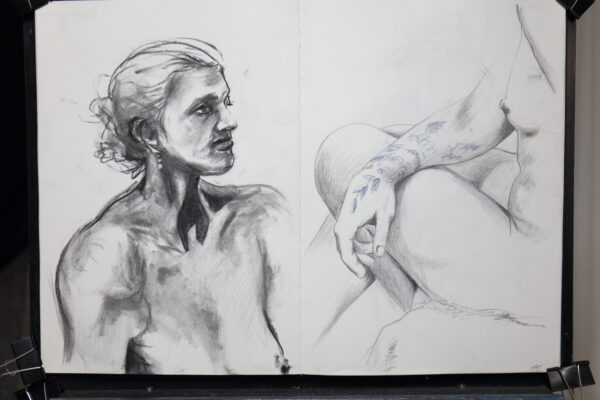
Later, a spread where the dialogue is already inside the picture. Left page: Elli in portrait register, bare-shouldered, hair wrapped in cloth. Matt graphite, tonal, patient. Right page: Elli’s tattooed hand cupped over a knee, the floral ink rendered on the paper in turquoise coloured-pencil (her colour).
Mass (sovereignty as weight)
Then a quieter page. A single figure, turned away. The looking-away figure revisits the session’s tool-contrast: fountain-pen pigment ink brushing against the ubiquity of graphite’s luring. The shoulder-marks (a name, a date, the same script as another spread) are ink; the surrounding mass is graphite and carbon, laid down in patient layers.
The gutter made visible (penultimate)
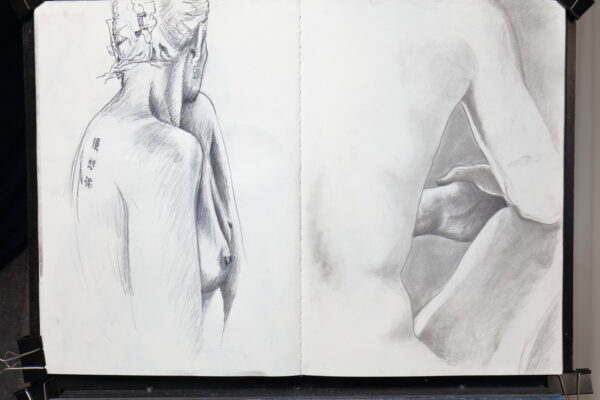
Left page: Elli back-turned, a hair-clip holding a cascading vortex of her hair, matt graphite contour hatching over fine charcoal powder blends — the charcoal laying in the mass, the graphite hatching reading across it. Shoulder blades and back built through the two layers talking to each other.
Right page: a zoom-in on a hand holding a knee, mostly blended pencil work now — an almost darkroom aspiration toward subtle tonality — the arm sweeping in from the top-right and ending near the gutter. One spread, two techniques. The gutter is also where a hatched surface meets a blended one.
And quieter, across the fold: the right outer edge of the back-figure on the left page also reads as the left (implicit) edge of the figure that unfurls from the right of the span. Waist on the left becomes the framing of elbow on the right.
The crop decision is what does the rest. The right-page composition chooses to stop near the spine: the arm’s vector almost touches the gutter. Faint ghost-marks sit in the upper-left, traces of a drawing that did not fully happen, left in. The binding itself becomes visible — the physical spine of the sketchbook, its texture of fallibility (creases, wear, the hand of the book).
Oh, and then it becomes the spine. Her spine, and not.
Portrait (the last page of the day)
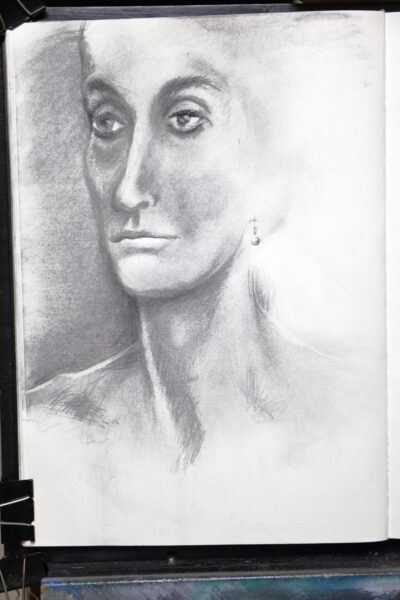
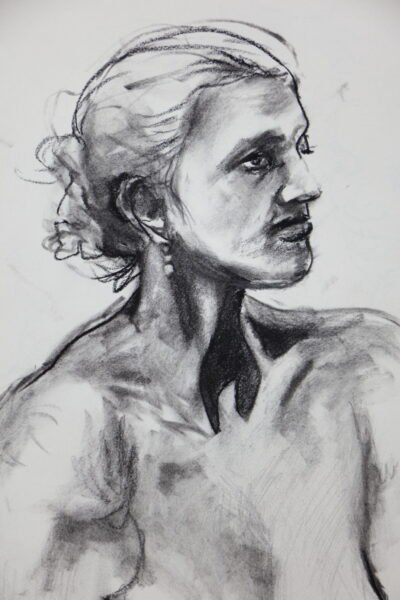
And then the terminal page. A countenance. The face sustains the weight just of the page.
The proportions have deviated (“you could go skiing down that nose,” she observed, graciously), and the observation is correct. And yet the tonal volumes persisted. Both obtain on the same page without negating each other, as they relax into a kind of simplistic naivité.