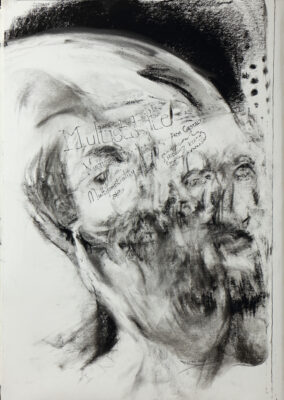
This page started as a studio problem, not an illustration: how to hold multiple readings in the same field without collapsing them into a single, “clean” hierarchy. The result became Multistate~ — a portrait-field engineered to code-switch, where faces cohere, dissolve, re-cohere, and the labels meant to stabilise perception keep getting outvoted by the material itself.
It’s made on A3 Hahnemühle 120gsm with charcoal, matte graphite, carbon ink, and charcoal dust recovered from discarded drawings (pyrolysis → pigment → return). That return-loop matters: the substrate isn’t just a passive surface; it has memory and a politics of residue.
Why “multistate” (and why Gestalt wouldn’t let go)
Gestalt gives a clean story about how perception snaps into wholes; multistability names the flip—how an ambiguous stimulus won’t stay put. That concept was on my mind because I’m currently working through IxDF’s “Gestalt Psychology and Web Design: The Ultimate Guide”, which explicitly includes a Multistability lesson alongside figure/ground and the usual grouping laws.
In UX, multistability is often treated as risk (confusion, misclicks, loss of conversion). In drawing, it can be treated as capacity: the ability for a page to carry more than one stable interpretation without becoming mere noise. The ambition here isn’t maximal ambiguity for its own sake; it’s managed ambiguity—a negotiated truce between competing wholes.
What’s actually going on in the image
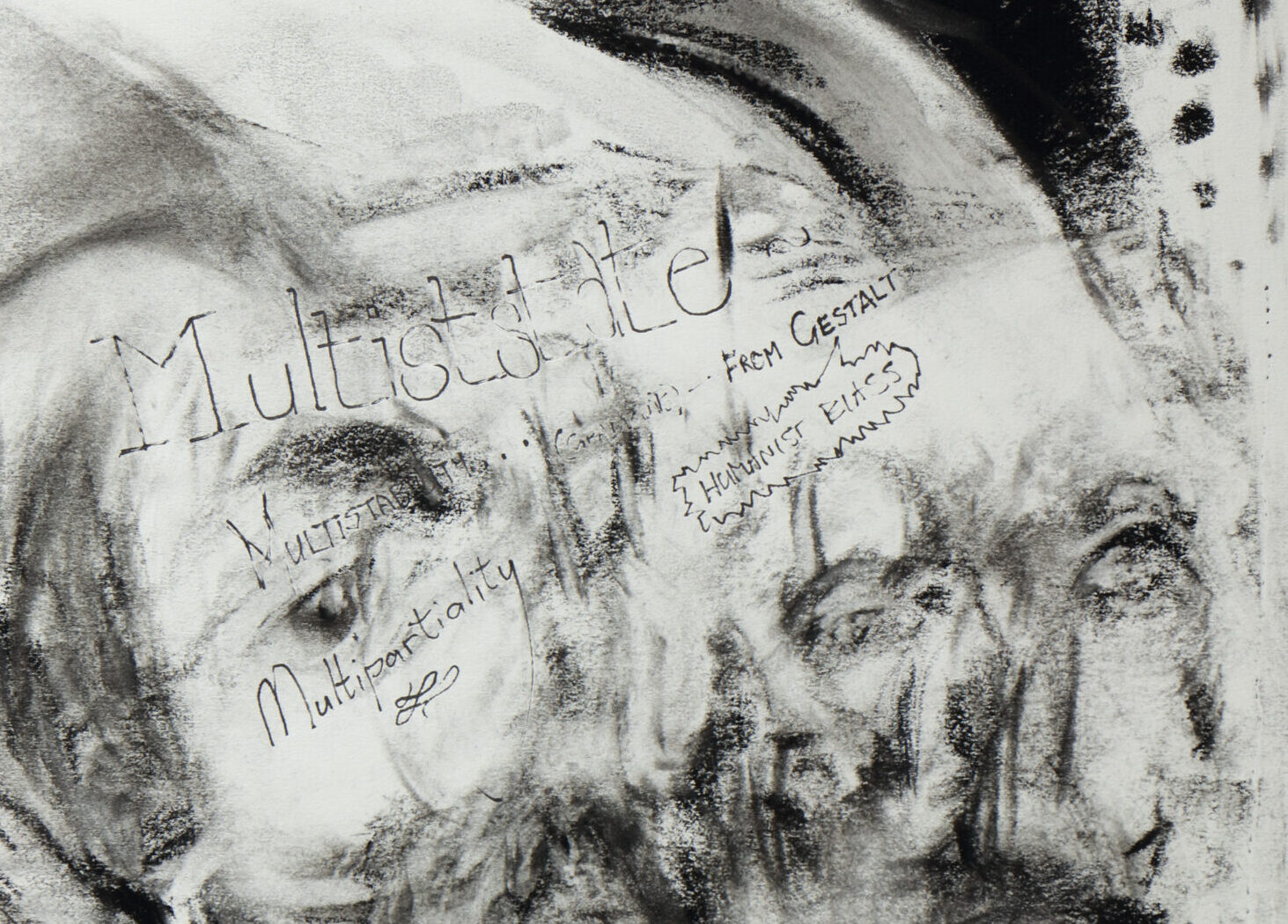
You can read it as “a face”, sure. But another valid read is: a torso-body rotating through multiple angles, wearing face-masks like weather systems. Edges that normally behave like anatomy start behaving like terrain. The “portrait” acts less like a subject and more like a field that keeps proposing alternate objects.
Key move: the text tries to govern the image. It functions like UX microcopy: a directive layer attempting to reduce interpretive degrees of freedom. But the drawing keeps arguing back—smear, erasure, redeposition, drift. The governance layer becomes another mark; another participant.
That tension—instruction vs emergence—is the point.
A personal lens (without turning it into a diagnosis postcard)
There’s a sense in which this page rhymes with what it can feel like to run an ADHD–autistic neurology: spending real energy stabilising overlapping, disparate mental states, while also mining the interesting stuff that emerges at the intersections. Not “superpower”, not tragedy—more like continuous perceptual systems engineering.
The drawing doesn’t claim to represent neurodivergence. It simply shares a structural mood: multiple interpretations competing for foreground, and a deliberate practice of not letting any single one become tyrant.
The page as a protocol (and why I keep dragging GitHub into art)
I’ve written elsewhere about siting work inside a repository—treating folders, files, and navigation as part of the piece (“the terrain is the first stanza”). That same instinct shows up here: this sketchbook page behaves like a repo.
- Layers = branches.
- Smears/ghosts = commit history.
- Text overlays = documentation trying (and failing) to fully specify behaviour.
- Signature at the throat = authorship as just another layer (not final authority; a light touch on a thing that already has its own voice).
For anyone curious about the broader “how I think while making” infrastructure, I keep (read am building as and when I get around to it) a living set of protocols and lenses in my GitHub README repo—particularly:
README.md(the “welcome mat” / operating stance)docs/lenses/(how I look, not just what I make)docs/models/SRII_AXIOLOGICAL_FRAMEWORK.md(constraints, validation, and the ethics of tooling)projects/theses/parametric_authorship.md(layered interventions; authorship as system, not ego)
(Those paths are literal—if you’re browsing the repo, start there.)
Close
Multistate~ isn’t asking to be decoded into a single meaning. It’s asking you to notice the moment your perception flips, and to stay present for the negotiation: figure/ground, mask/substrate, instruction/residue, identity/field.
In other words: a portrait that refuses to be only a portrait.
Dated: ~ January 2026
Materials: A3 Hahnemühle 120gsm; charcoal, matte graphite, carbon ink; charcoal powder via pyrolysis of discarded drawings