Oil on canvas · 96 × 96 cm · 2026
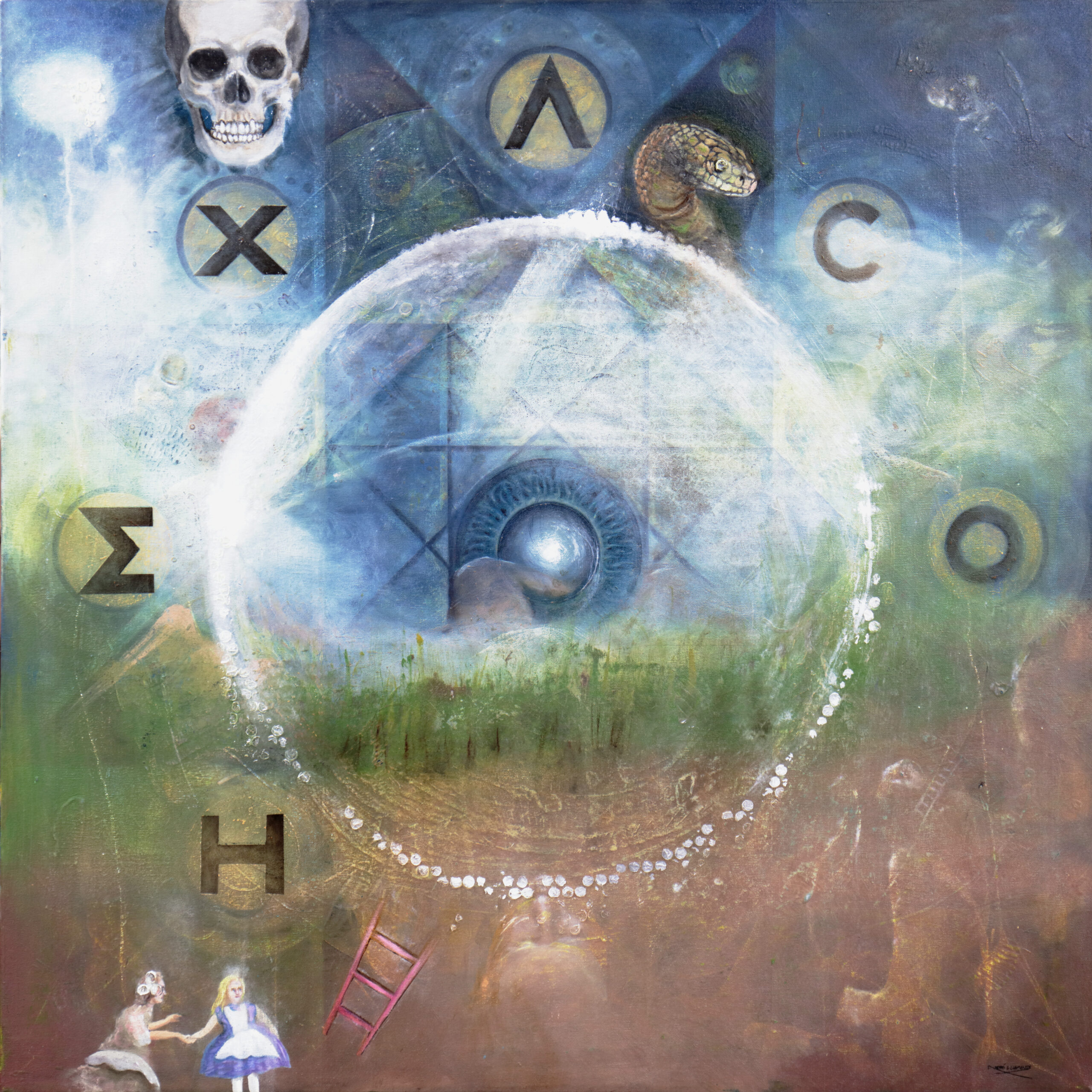
’Tis all snakes and ladders, isn’t it? functions as a lived diagram: a nocturnal gameboard where character, chance, and mortality remain in continuous negotiation. At the centre sits a luminous sphere—simultaneously biological eye, protective bubble, and planetary lens—returning the viewer’s gaze with a calm, systemic insistence. This central eye acts as a temporal mirror, where the act of looking into the future is met by the future looking back.
Structural scaffolding: the tesseract
Beneath the misted surface, the work is anchored by an orthographic projection of a tesseract (hypercube). This geometric framework introduces a condition of multipartiality: a reality with extra faces where objects cannot be reduced to a single perspective. The grid serves as a quiet insistence on dimensionality, allowing luck and order, spirit and packaging, to coexist without collapsing into a singular narrative.
The painting distributes attention across its elements—magenta ladder, serpent, skull, and psychometric tokens—without granting any one of them final authority.
Avatars of observation: the Alice–Infanta hybrid
In the lower register, a diplomatic encounter unfolds between two iconic figures of structured girlhood. Velázquez’s Infanta Margarita, caught within the etiquette of the Spanish Court, is hybridised with Lewis Carroll’s Alice, navigating the shifting rules of Wonderland. Attended by a servant figure wearing a bubble-wrap bloom, they represent the subject of the game: the self as both mover and observed object.
This nested scene is haunted by a ghost sitter at the lower right margin. Suggested through sgraffito and the grid’s drift into the ground tone, the figure persists as witness and residue—present, but not fully declared.
Psychometric tokens: the HEXACO halo
The perimeter is ringed by the HEXACO personality factors, rendered as pseudo-Greek tokens (Σ, Λ, X, C, H, O). This deliberate “Big Six” topology highlights what dominant metrics often background: Honesty–Humility (H). Positioned in the earth register, the “H” factor is treated as a foundational anchor rather than a decorative trait. The metrics of character orbit the core, governed by the inevitable gravity of the hovering memento mori skull.
Materiality: plastic on the moon
The aesthetic logic of the work—defined as “Plastic on the Moon”—explores the tension between the sacred and the disposable. Atmospheric mists and sentinel geometry are met by bubble-wrap textures, synthetic magenta, imprint, and abrasion. It is a recognition that even our most esoteric pursuits arrive mediated—handled by systems, metrics, and material residues.
Availability
Price: R 3 333.33
The work is finished with a retoucher’s varnish layer to unify nocturnal values and surface history. For acquisition enquiries or to view the piece in Pretoria, please contact the studio directly.
TLDR:
Square oil painting garnished with touches of bubble-wrap, of a misted nocturnal gameboard with a central eye-like sphere inside a tesseract grid. A skull and serpent hover above. HEXACO tokens ring the field. At the bottom, Alice and the Infanta appear beside a magenta ladder; a ghostly sitter lingers at the right edge.